
India’s electricity bills are climbing. Moreover, Power cuts remain a daily reality across many states. And yet, solar energy — as effective as it is during daylight hours — cannot power your home or business at 10 pm. This is exactly the gap that battery energy storage (BESS) in India is designed to fill.
The battery energy storage India market was valued at $1.59 billion in 2025 and is projected to reach nearly $20 billion by 2035, growing at a CAGR of 29.1%. In fact, the reason is simple: generating clean energy is only half the equation. Storing it intelligently is the other half.
In this guide, Iconiq Energy covers everything you need to know about battery energy storage systems in India — how they work, what they cost in 2026, and which government subsidies are available to you.
How does a BESS work?
A Battery Energy Storage System stores electrical energy in batteries and releases it when you need it most. In other words, think of it as a high-capacity, intelligent power bank — one that sits between your energy source (solar panels or the grid) and your appliances.
Simply put, the core principle is: charge when power is available or cheap, discharge when it isn’t.
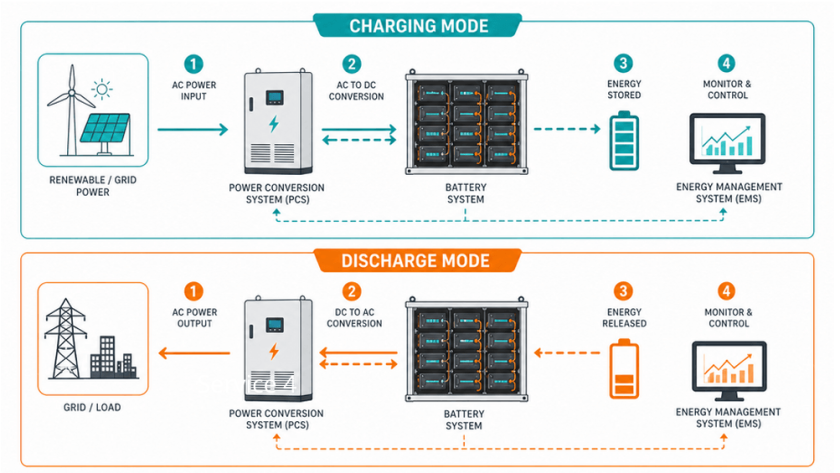
The 3-step energy cycle: collect, store, release
BESS operates in three straightforward steps:
- Collect — Solar panels or the electricity grid generate power. Any surplus beyond your immediate consumption flows into the battery system.
- Store — The BESS holds this energy chemically inside battery cells, safely and efficiently, until you need it.
- Release — During evening hours, power cuts, or peak tariff windows, the BESS discharges — delivering stored electricity directly to your home or facility.
How a hybrid inverter fits into a BESS
Importantly, a BESS does not work alone. Inevitably, it needs a hybrid inverter — the intelligent controller that manages power flow between your solar panels, battery, grid, and appliances.
Think of the BESS as the fuel tank and the hybrid inverter as the engine management system. Together, they ensure you always have power at the lowest possible cost.
Learn more about our hybrid inverter solutions
Types of Battery Energy Storage in India
Remember, not all BESS are the same. Here are the four main battery types available in India and where each makes sense.
Lithium-ion (LFP) — most common for homes & businesses
Lithium Iron Phosphate (LFP) batteries are the most widely adopted option for residential and commercial BESS in India. Key advantages include:
- High energy efficiency: 90–95%
- Long cycle life: 3,000–6,000 charge cycles
- Lifespan: 10–15 years
- Safe chemistry — no thermal runaway risk at Indian operating temperatures
- Rapidly falling costs: LFP cell prices have dropped from $300/kWh in 2018 to $75–90/kWh in 2026
Hence, for most Indian homes and businesses, LFP is the recommended choice.
Lead-acid — older, budget option
In contrast, lead-acid batteries are the traditional choice — lower upfront cost, but higher maintenance requirements and a shorter lifespan of 3–5 years. As such, they suit small, low-budget off-grid setups where upfront cost is the primary constraint.
Flow batteries — for large industrial use
Meanwhile, flow batteries use liquid electrolytes stored in external tanks and are designed for large-scale, long-duration storage (6–12+ hours). In addition, they offer near-unlimited cycle life and excellent scalability — ideal for industrial facilities, microgrids, and utility-scale applications.
Sodium-ion — the emerging option for Indian climate
Finally, sodium-ion batteries are gaining attention in India specifically because they perform well in high-temperature conditions — making them well-suited to Indian summers. Still emerging commercially, they represent the next wave of cost-effective storage technology.
| Battery Type | Best For | Lifespan | Efficiency | Relative Cost |
|---|---|---|---|---|
| Lithium-ion (LFP) | Homes, commercial, industrial | 10–15 years | 90–95% | Medium–High |
| Lead-acid | Small off-grid, budget setups | 3–5 years | 70–80% | Low |
| Flow | Large industrial, utility-scale | 20+ years | 65–80% | High |
| Sodium-ion | High-temperature climates | 8–12 years | 85–90% | Medium (falling) |
Key benefits of Battery Energy Storage in India: Homes and Businesses
Here are the four most compelling reasons Indian homes and businesses are investing in battery storage.
No more power cuts — 24/7 uninterrupted supply
Notably, India’s grid reliability varies significantly by state. And in this uncertainty, a BESS switches to stored power in milliseconds during an outage — with zero disruption to your appliances, equipment, or operations. Unlike a diesel generator, a BESS produces no noise, no fumes, and zero running fuel cost.
Reduce electricity bills by up to 40%
One of the most powerful applications of BESS in India is peak demand shifting. Electricity tariffs are significantly higher during peak hours (typically 6–10 pm). A BESS charges during off-peak hours and discharges during peak hours — meaning you buy less expensive grid power precisely when it costs the most. As a result, commercial and industrial users on Time-of-Day (ToD) tariffs regularly achieve electricity bill reductions of 30–40%.
Store solar energy for use at night
However, solar panels generate power only during daylight. Otherwise, surplus energy either goes to waste or is exported at low grid buy-back rates. Instead, a BESS captures that surplus and makes it available at night — dramatically increasing your solar self-consumption and reducing grid dependence.
Protection from rising electricity tariffs
Electricity tariffs in India have risen consistently over the past decade. Therefore, by investing in a BESS today, you lock in a portion of your energy supply at a fixed cost — hedging against future tariff increases.
Want to know how much you can save with a BESS?
Get a free energy assessment from Iconiq Energy.
Battery Energy Storage in India : Cost in 2026?
Current price range for residential Battery Energy Storage in India
For a typical Indian home with a 3–5 kW solar system and 5–10 kWh of storage, BESS costs in 2026 range from approximately ₹2.5–5 lakh depending on battery chemistry, capacity, and brand. LFP-based systems with a hybrid inverter sit at the higher end but deliver significantly better long-term value over their 10–15 year lifespan.
Commercial & industrial BESS pricing
For commercial and industrial users, BESS is priced per kWh of storage capacity. In fact, the cost decline has been steep: competitive bids in India have fallen from ₹10.18/kWh (2022–23) to approximately ₹2.8/kWh (2025–26, based on 1.5 cycles/day utilisation), according to the Ministry of Power. Behind-the-meter commercial and industrial systems are priced above utility scale, but the trend is sharply downward.
Payback period and ROI
Overall, for most commercial users in India, a BESS paired with solar delivers a payback period of 4–6 years, against a system lifespan of 10–15 years — meaning 6–10 years of significantly reduced energy costs after payback is achieved. For industrial facilities with high peak tariffs, payback can be as short as 3 years.
Not sure what size BESS your home or business needs?
Talk to our experts →
Government schemes & subsidies for Battery Energy Storage in India
Notably, the Indian government has committed substantial funding to accelerate BESS adoption across the country.
Did you know? The government has allocated over ₹27,000 crore across VGF, PSDF, and PLI schemes to support battery storage deployment in India.
Viability Gap Funding (VGF) scheme
Specifically, the Ministry of Power has approved ₹3,760 crore in VGF support for 13,220 MWh of BESS capacity, with projects eligible for up to 40% of capital cost as a direct central grant. In June 2025, a second tranche of ₹5,400 crore was launched through the Power System Development Fund (PSDF) for an additional 30 GWh of BESS capacity.
Source: Press Information Bureau, Ministry of Power
PLI scheme for Advanced Chemistry Cells (ACC)
Furthermore, the Ministry of Heavy Industries launched a Production Linked Incentive (PLI) scheme with an outlay of ₹18,100 crore to establish 50 GWh of domestic Advanced Chemistry Cell (ACC) battery manufacturing capacity in India. As a result, this is driving domestic LFP cell production, and will continue pushing BESS costs down through 2026–27.
State-level incentives to know about battery energy storage system (BESS) in india
Additionally, several states have introduced BESS-specific provisions:
- Maharashtra: BESS-equipped consumers can participate in demand response programmes and earn payments for reducing load on request.
- Karnataka: KERC has introduced BESS-specific tariff provisions allowing consumers to use BESS for net metering on self-generated solar with storage.
- Other states are progressively introducing similar frameworks under the National Framework for Promoting Energy Storage Systems.
Make sure that you check with your state electricity regulatory commission (SERC) for the latest applicable incentives in your state.
Who should install Battery Energy Storage (BESS) in India ?
Homeowners with solar panels
If you already have rooftop solar, a BESS is the natural next step. Note that it stores your daytime solar generation for evening use — turning a daytime-only system into genuine 24/7 clean power, and maximising the return on your solar investment.
Commercial buildings and offices
For example, offices, retail spaces, hospitals, hotels, data centres, and educational institutions — any facility with high electricity consumption and sensitivity to downtime will benefit substantially from BESS. In fact, Peak demand shifting alone can generate significant annual savings.
Factories and industrial facilities
In particular, industries with continuous production processes, high connected loads, or multi-shift operations are ideal BESS candidates. A BESS reduces maximum demand charges, provides backup against grid failures, and — combined with solar — can dramatically reduce annual energy expenditure.
How to choose the right BESS for your needs
Ultimately, choosing the right system depends on five key factors:
- Your energy consumption — How many kWh do you use per day, and during which hours?
- Your solar system size — If you have solar, what is your generation vs. consumption pattern?
- Your primary goal — Cost reduction, backup power, or both?
- Battery chemistry — LFP for most residential and commercial applications; flow or larger lithium systems for industrial scale.
- Inverter compatibility — The BESS must be paired with a compatible hybrid inverter for optimal performance and system lifespan.
Therefore, at Iconiq Energy, we conduct a thorough energy assessment before recommending any system — because the right BESS is one sized precisely to your needs, not simply the largest option available.
Frequently asked questions about Battery Energy Storage in India
What is a Battery Energy Storage System (BESS)?
Essentially, a Battery Energy Storage System (BESS) is a technology that stores electrical energy — typically from solar panels or the electricity grid — in batteries, and releases it on demand. Specifically, it is used in homes and businesses to ensure uninterrupted power supply, reduce electricity bills, and maximise the value of solar energy generation.
How much does a battery energy storage system (BESS) cost in India 2026?
Residential battery energy storage India systems (5–10 kWh capacity) typically cost ₹2.5–5 lakh in 2026, depending on battery type and capacity. Meanwhile, for commercial and industrial users, pricing is quoted per kWh of storage. Additionally, Utility-scale bid costs have fallen from ₹10.18/kWh (2022–23) to approximately ₹2.8/kWh (2025–26), reflecting the rapid cost decline across the industry.
Is there a government subsidy for battery energy storage system (BESS) in India?
Yes. Specifically, the Ministry of Power’s Viability Gap Funding (VGF) scheme provides up to 40% of capital cost as a direct grant for eligible BESS projects. Additionally, the PLI scheme for Advanced Chemistry Cells (₹18,100 crore outlay) is also driving down domestic manufacturing costs, benefiting end consumers. More details are available at pib.gov.in.
What is the difference between a BESS and a hybrid inverter?
Essentially, a BESS is the battery storage system that holds the energy. On the other hand, a hybrid inverter is the intelligent controller that manages how that energy flows between your solar panels, battery, grid, and appliances. They both are separate components that work together — and the quality of both determines your overall system performance and efficiency.
What is the lifespan of a battery storage system?
LFP (Lithium Iron Phosphate) batteries — the most common choice in India — have a lifespan of 10–15 years, equivalent to 3,000–6,000 charge cycles. Lead-acid batteries last 3–5 years. Therefore, choosing LFP results in a significantly lower cost per cycle over the system’s working life.
Can a BESS work without solar panels?
Yes. In fact, a BESS can charge directly from the electricity grid — particularly during off-peak, low-tariff hours — and discharge during peak hours or outages. Inevitably this makes it a valuable tool for peak demand shifting and backup power, even for users who do not have solar panels installed.
Indeed, India’s energy transition is accelerating, and battery energy storage in India is no longer a future technology — it is delivering real savings to Indian homes, businesses, and industries today.
So whether you want to maximise your solar investment, protect your operations from power cuts, or reduce your electricity costs, Iconiq Energy has the expertise and the right BESS solution for you.
Want to know how much you can save with a BESS?
Get a free energy assessment from Iconiq Energy.