
Choosing the wrong inverter architecture is one of the most expensive technical decisions a commercial or industrial (C&I) site in India can make — not because of the hardware itself, but because of what it locks you out of later. A hybrid inverter and a string inverter both turn DC into usable AC, but they are built for very different jobs, and the gap between them shows up exactly when your facility needs it most: during a grid outage, a demand spike, or the day you decide to add battery storage.
This guide breaks down the practical differences between a hybrid inverter and a string inverter for Indian C&I projects — how each handles energy sources, backup, storage and three-phase loads — so you can match the architecture to how your facility actually runs.
What a string inverter actually does ? (and where it stops !)
A string inverter has one core job: take the DC output from a connected series (“string”) of solar PV panels and convert it into grid-synchronised AC that your facility can use or export. It is a grid-tied device, optimised for efficiently harvesting energy from a PV array while the grid is up.
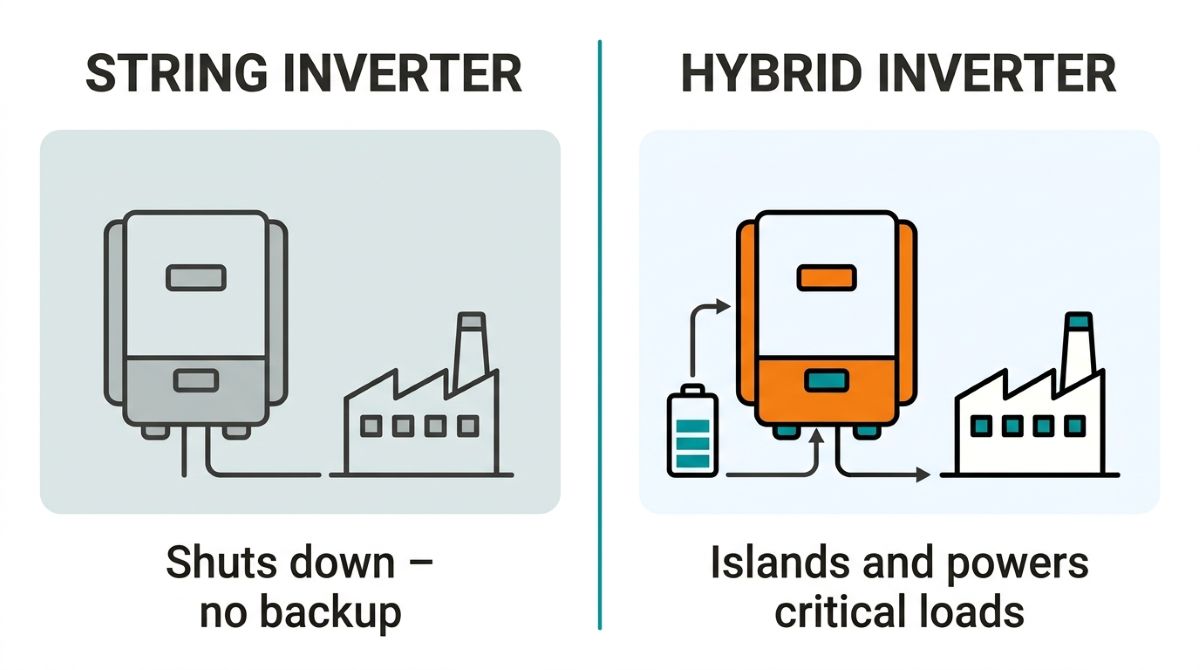
That focus is also its limit. A conventional string inverter has no native battery management — it does not charge or discharge a storage bank on its own. If you want to store energy, you have to AC-couple a separate battery inverter alongside it, which adds hardware and extra conversion stages. And because grid-tied inverters must follow anti-islanding protection rules, a string inverter shuts down the moment the grid drops. The instant your facility most needs power, a pure string setup goes dark with it.
For a site that only wants to offset daytime consumption from a PV array and has no backup or storage requirement, that trade-off can be perfectly acceptable. For most Indian C&I operations dealing with outages, load variability and uptime-critical processes, it leaves too much on the table.
What a hybrid inverter does differently ?
A hybrid inverter is built to manage multiple energy flows at once. It converts DC to AC and back again, coordinating a connected battery, the grid, a generator and — where present — a solar PV array. Storage is integrated through a native, DC-coupled battery port rather than bolted on afterwards, which keeps the energy path shorter and round-trip efficiency higher than an AC-coupled retrofit.
Two capabilities matter most for C&I sites. First, islanding: when the grid fails, a hybrid inverter can disconnect cleanly and keep designated critical loads running from the battery, behaving like a large-scale UPS for the parts of your operation that cannot stop. Second, active energy management: it can charge the battery when supply is plentiful and discharge it to support loads during high-demand windows, shifting consumption away from peak tariff periods without manual intervention.
Crucially, none of this depends on solar. Iconiq Energy hybrid inverters are source-agnostic — they work across grid, generator, solar PV and battery in any combination. A facility can run a hybrid inverter purely on grid-plus-battery today and add a PV array later, with no change to the core architecture.
Hybrid inverter vs string inverter: side-by-side comparison
The table below summarises how the two architectures differ on the points that decide most C&I projects in India.
| Dimension | String inverter | Hybrid inverter |
|---|---|---|
| Primary job | DC→AC from a solar PV string; grid-tied self-use or export | DC↔AC across battery, grid, generator and PV |
| Battery storage | Not native — needs a separate AC-coupled battery inverter | Built-in DC-coupled battery port |
| Power during a grid outage | Shuts down under anti-islanding rules — no backup | Islands and runs critical loads from the battery |
| Energy sources | Solar PV only | Source-agnostic: grid / generator / solar / battery |
| Round-trip efficiency with storage | Lower — extra conversion through AC coupling | Higher — direct DC-coupled storage path |
| Three-phase C&I scaling | Available, but PV-centric | LV & HV three-phase plus single-phase range for mixed loads |
| Best fit | Pure grid-tied PV with no storage or backup need | Sites needing storage, backup, load management or a BESS-ready setup |
Which one fits your C&I project in India?
The decision usually comes down to a single question: does your facility need to do anything with power beyond consuming it while the grid is available? If the answer is no, a string inverter may suffice. If the answer is yes — backup, storage, load shifting, or all three — a hybrid inverter is the architecture that keeps those options open.
When a string inverter is enough
A string-only setup can make sense for a site with a stable grid connection, no uptime-critical processes, no plan to add battery storage, and a straightforward goal of offsetting daytime consumption from a PV array. In that narrow case, the simplicity is a feature.
When a hybrid inverter is the better call
For the majority of Indian C&I sites, the hybrid inverter wins because it solves problems a string inverter cannot touch: keeping critical loads alive through outages, integrating a battery energy storage system natively, managing demand across the day, and giving you a single architecture that scales as your needs grow. Even if you start without solar, the hybrid inverter is ready for it — and ready for storage — whenever you are.
Not sure which hybrid inverter configuration fits your site?
Matching hybrid inverter to your load
Once you’ve decided on a hybrid architecture, the next step is sizing it to your connection and load profile. Inverter selection in India should respect the relevant safety and grid-interconnection standards — including the IEC 62109 series for converter safety and IEC 62116 for islanding-prevention testing — which define how an inverter must behave on the grid and during a fault. You can review these standards via the International Electrotechnical Commission (IEC).
Iconiq Energy offers a hybrid inverter range that maps to the spread of C&I requirements:
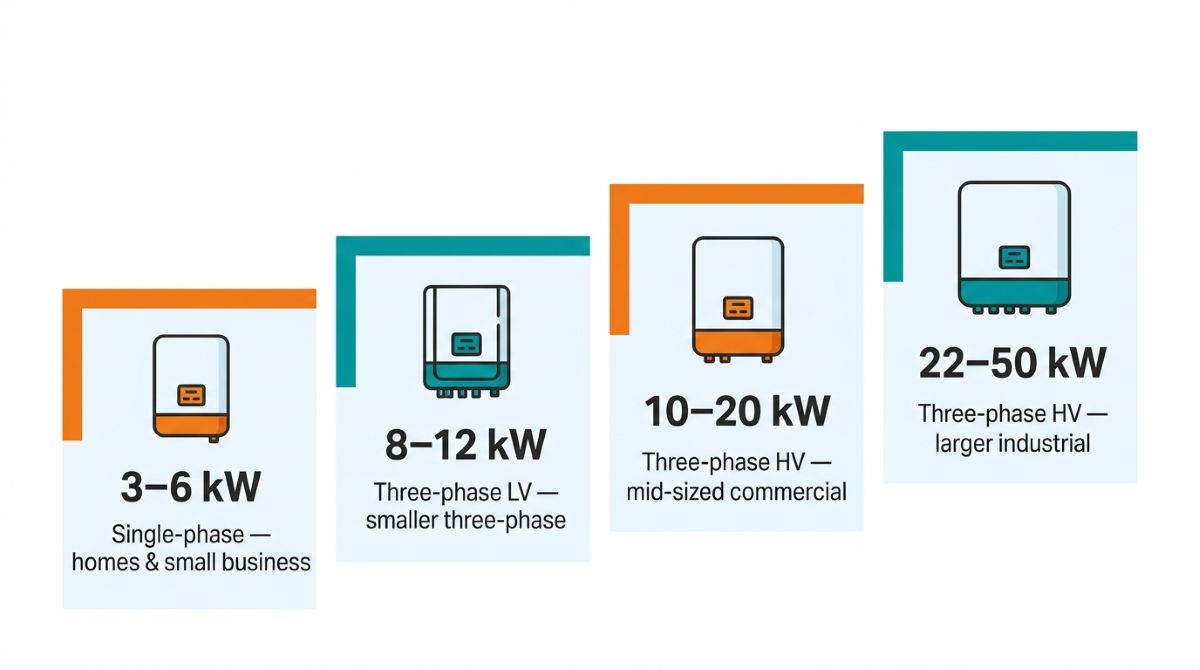
- 3-Phase HV hybrid inverter, 10–20kW — for mid-sized commercial loads.
- 3-Phase HV hybrid inverters, 22–50kW — for larger industrial sites.
- Three phase hybrid inverter, LV 8–12kW — for smaller three-phase setups.
- Single phase hybrid inverter, 3–6kW — for homes and small businesses.
If you’re weighing storage chemistry alongside the inverter, our LFP battery page covers the lithium iron phosphate options that pair with these units. You can also checkout the full hybrid inverter range.
Not sure which hybrid inverter architecture fits your site?
Get a configuration recommendation from Iconiq Energy for your C&I project.
Frequently asked questions
Does a hybrid inverter need solar panels to work?
No. A hybrid inverter is source-agnostic — it can charge from the grid or a generator and run your loads from a connected battery, with or without a solar PV array. You can add PV later without changing the core setup.
Can I add battery storage to a string inverter later?
Yes, by AC-coupling a separate battery inverter alongside it — but that adds hardware and extra conversion stages. A hybrid inverter integrates storage natively through a DC-coupled battery port, which is simpler and more efficient.
Will a hybrid inverter keep my facility running during a power cut?
Yes. A grid-tied string inverter disconnects during an outage under anti-islanding rules, but a hybrid inverter can island and supply your designated critical loads from the battery, much like a large UPS.
What’s the difference between a hybrid inverter and an inverter battery?
An inverter battery typically means a battery paired with a basic backup inverter for short outages. A hybrid inverter is a more capable unit that manages PV, grid, generator and a high-capacity battery together for continuous C&I energy management.
Is a hybrid inverter suitable for three-phase commercial loads in India?
Yes. Iconiq Energy offers LV and HV three-phase hybrid inverters for commercial and industrial loads, alongside single-phase units for smaller sites.